What to Leave for Your Pet Sitter: Info, Supplies and House Prep

By Pettify Team
Published 9 min read
What to leave for your pet sitter comes down to three things: written instructions for a normal day, supplies for the whole trip, and an emergency plan with your vet's details and the nearest 24-hour clinic. Go over it with the sitter in person, and tell your vet clinic who can make decisions while you're away.

Key takeaways
- Write down how to reach you, your travel dates, feeding amounts and times, each medicine with its dose, and the daily routine.
- Leave plenty of food, enough medicine for every dose of the trip, and show the sitter where the carrier, leash and cleaning supplies are.
- Before you leave, tell your vet clinic who is caring for your pet and ask how they handle consent and payment for treatment.
- Meet the sitter at home before the trip, go over medicines in person and agree on how they'll send you updates.
On this page
The short checklist
Everything a pet sitter needs falls into three groups. If you have ten minutes, cover these, then fill in the details from the sections below.
| Information | Supplies | Emergency |
|---|---|---|
| Your phone number and travel dates | Food for the whole trip, plus extra | Your vet's name, phone and address |
| A backup contact nearby | Medicines in a pet-resistant container | The nearest 24-hour emergency clinic |
| Feeding amounts and times | Leash, bags, bowls, litter | ASPCA Animal Poison Control: (888) 426-4435 |
| Each medicine: dose, time, how to give it | The carrier or crate | A person who can make decisions if you can't be reached |
| The daily routine, habits and fears | Cleaning supplies | A treatment authorization with a spending limit |
| Age, weight, health issues, microchip | Keys, plus a spare with a neighbor | What the sitter should do first |
Tip
Turn this list into one printed page. Our free pet sitter instructions generator walks you through contacts, the vet and 24-hour clinic, food, medicines, house notes and the daily routine, then prints the sheet or saves it as a PDF. What you type stays in your browser and is never sent to us.
If family members share the care when you're home too, the same who-does-what thinking from our shared pet care schedule makes the handover easier: the sitter takes over a routine that already exists on paper.
What information to leave for a pet sitter
Leave in writing everything you would say at the door, because the sitter can't ask you in the middle of a walk. The ASPCA Animal Poison Control Center's checklist for leaving pets with a sitter covers how to reach you, your itinerary, emergency contacts, your pet's details, vet details, medicines, the daily routine and an emergency plan.
Contacts
- You. Your cell phone and at least one other way to reach you. The American Kennel Club (AKC) suggests several forms of contact.
- A backup person nearby. The ASPCA suggests someone you trust who knows your pets and can make sound medical decisions if you're out of reach. AKC adds: ask them before you list them.
- Your vet. Name, phone number and address.
- The nearest 24-hour emergency clinic. Add the address, so the sitter knows where to drive.
- ASPCA Animal Poison Control: (888) 426-4435. It answers 24 hours a day, 365 days a year, and a consultation fee may apply.
Pet profile
For each pet, write down age, weight, current health issues, medications, regular diet and microchip information. The ASPCA notes these details can be critically important if an emergency happens while you're gone. AKC also suggests leaving a list of vaccinations with the dates given; a filled-in pet vaccination record does that job. If you have more than one dog, especially of the same breed, AKC suggests ID tags on each collar so the sitter can tell them apart.
Feeding
Write the food, the exact portion and how many times a day. "1 cup at 7 a.m. and 6 p.m." leaves less room for guessing than "feed twice a day." AKC suggests labeling food containers when pets eat different diets and noting the feeding order if you have several pets; our guide to a multi-pet household covers separate feeding spots and medicine boxes. Say which treats are allowed and which foods are off-limits.
Medicines
For each medicine, list the name, the dose exactly as it's written on the vet's label, the time and how often. The ASPCA recommends going over this list with the sitter in person, and AKC suggests showing them how you give the dose. If you're not sure what the sitter should do about a missed dose, ask your vet before you leave and write the answer down. A printable pet medication log lets the sitter mark each dose with the time.
Daily routine and behavior
The ASPCA lists how much food your pet gets and when, normal walk times and, for cats, their usual hiding spots, which helps the sitter keep an eye on a nervous cat. AKC notes that keeping your dog's usual schedule can make the change easier. Add what's normal for your pet, like barking at the mail carrier or hiding from new people, so the sitter knows what not to worry about.
Your trip
Write down your dates, where you'll stay with the phone numbers there, your time zone and when you can answer. The ASPCA points out that an itinerary helps the sitter know when you may or may not be available.
Supplies to leave, and how much
Leave supplies for the whole trip where the sitter can find them and your pet can't reach them. AKC's checklist asks for "plenty of food," enough medicine for the duration of the trip, and a physical key even if you have a keypad lock, because keypad batteries can die.
| Supply | How much | Where |
|---|---|---|
| Food | Daily amount × days away, plus extra | Labeled, out of your pet's reach |
| Medicines | Every dose of the trip, counted before you go | Pet-resistant container, out of reach |
| Treats | Only what your instructions allow | Next to the food |
| Litter (cats) | Enough for every day you're away | Next to the litter box |
| Leash, poop bags, bowls | Your usual set | One visible spot |
| Carrier or crate | Your pet's usual one | Tell the sitter where it is |
| First aid kit | If you have one | Tell the sitter where it is |
| Cleaning supplies | Your usual set | Obvious place, out of reach |
| Keys | One set for the sitter, a spare with a neighbor | Hand them over in person |
How to prepare your house for a pet sitter
Make the house safe for a pet who will spend more time alone, and easy to run for a sitter who doesn't know where anything is. AKC notes that stressed pets may do things they wouldn't do with you at home.
- Move plants, trash and cleaning supplies out of your pet's reach.
- Put away dog toys that could be a choking hazard. For cats, Cats Protection suggests leaving favorite toys out and putting string-like toys, such as feather wands, out of reach.
- Check that the backyard is secure.
- Test the doors and locks with the sitter, and leave a backup key with someone you know.
- Write down alarm codes, where to turn off the water, where the circuit breakers are, your landlord's name and number, and anyone else who may come into the house.
- Tell a neighbor or your landlord that a sitter is coming, and give them the sitter's number.
- If your cat is sensitive to change, spread cleaning and packing over a few days instead of doing it all at once.
Emergency plan and vet authorization
An emergency plan answers three questions before anything happens: who decides, who pays, and what the sitter does first. The ASPCA suggests mapping out the plan and telling the sitter exactly what you'd like them to do.
- Call your vet clinic. Tell them when you'll be away and who is authorized to make decisions about your pet, as the ASPCA recommends.
- Ask about their form. Ask your vet clinic whether they use their own authorization form and how payment works when you're not there.
- Decide on a spending limit. AKC notes that many pet sitters ask owners to fill out a form describing the care your pet can receive if you can't be reached, including a spending cap. If yours doesn't, consider writing one.
- Name who drives. If the sitter has no car, ask your backup contact whether they can take your pet to the clinic.
As one example of what such a form covers, Cornell University's College of Veterinary Medicine has published a Pet Caretaker Treatment Authorization. It lists the dates the authorization is valid, how to reach you and the caretaker's details. You choose whether the caretaker can make all medical decisions or the hospital should contact you first, with a backup person if you can't be reached. You also choose between "any amount necessary" and a maximum dollar amount, and name who pays at the time of service.
Important
If the sitter thinks your pet has eaten or been exposed to something poisonous, they should call your vet or ASPCA Animal Poison Control at (888) 426-4435 right away. Put the number on the first page of your instructions.
Dog vs cat: what's different
Most of the list is the same for dogs and cats. The differences are in visits, toilet routine and where things can go wrong.
| Dogs | Cats | |
|---|---|---|
| Visits | Built around walk and meal times; agree on them with the sitter | Cats Protection suggests at least twice a day, more for very young, old or unwell cats |
| Toilet | Walk times, leash rules, poop bags | Where the litter box and litter are |
| Escape risk | Secure the backyard; say whether to keep the dog on a leash | Say whether the cat goes outside and when it should be back in |
| Toys | Put away anything your dog could choke on | Leave favorites out; string-like toys out of reach |
If your cat has a health condition, ask your sitter and your vet clinic how many visits a day it needs.
Leaving your dog with a sitter for the first time
Meet first, then hand over. Humane World for Animals advises that you and your pets meet a candidate before you book, so you can see how they interact with your animal, and suggests a trial walk to see how they handle your dog. Cats Protection gives similar advice for cat sitters: meet at your home as early as you can, or at least a few days before you leave.
At that meeting:
- Go over medicines in person and show how you give them.
- Ask whether they're comfortable giving medication and what their backup plan is if something stops them from coming.
- Pose a scenario, as Humane World for Animals suggests: what would they do if the air conditioning broke on a hot day or your pet started vomiting?
- Agree on updates. Humane World for Animals suggests asking for notes about each visit or photos by text or email.
Share care in real time with Pettify
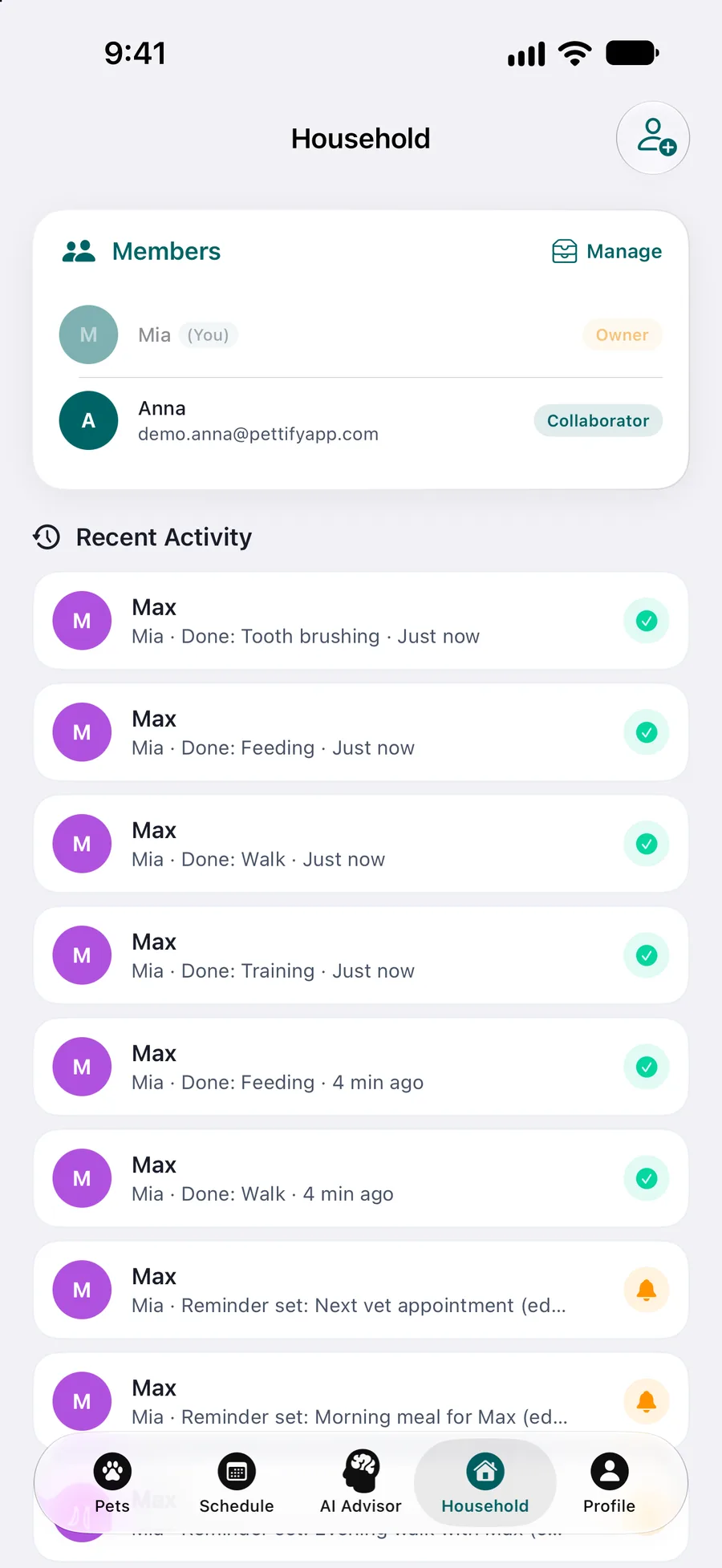
A printed sheet covers the plan, but it can't tell you whether dinner happened. Pettify, our app for iPhone, iPad, Mac and Apple Vision Pro, can. You invite someone by email or QR code and choose whether they can edit or only view. Everyone sees the same diary and care plan and gets a notification when someone else logs care. Once a task is ticked off on one phone, its reminder stays quiet on the others, so the dog gets fed once, not twice.
Before you go, you can also export a PDF report from your pet's profile with vaccinations, vet visits, health records and the care plan, and leave it with the sitter's papers. Pettify costs $4.99 a month, or $49.99 a year with a 7-day free trial first (US App Store prices).
Your countdown: a week out, the day before, departure day
Spread the prep over a week, so the last day is only about the handover.
| When | What to do |
|---|---|
| A week or more before | Book the sitter and a backup. Meet at home. Call your vet clinic about consent and payment. Ask your emergency contacts if they agree. Check that every medicine will last the trip. |
| The day before | Label food, set out supplies, put medicine in a pet-resistant container, clear away hazards, and print the instructions sheet. |
| Departure day | Hand over the keys, go over medicines in person if you haven't yet, leave the sheet next to the food and send a copy to the sitter's phone. |
Frequently asked questions
What should I ask a pet sitter before hiring them?
Humane World for Animals suggests asking how long they've been in business, how much experience they have with your species and whether they're bonded and insured, which could protect you if, say, your dog bites someone on a walk with the sitter. Ask for references and copies of their bonding and license, and you may want a criminal background check.
How can I check that the sitter is visiting as agreed?
Humane World for Animals suggests a few simple checks. A doorbell camera, if you have one, shows whether the sitter comes at the agreed times, and a GPS tracker on your dog's collar shows whether the walks happen. Treats or toys you left for the sitter to give that stay untouched, or visit reports without detail, are worth a polite question.
What should I leave for a pet sitter who stays overnight?
Add house notes for a guest: where to sleep, which bathroom to use, how the heating, air conditioning and TV work, and whether doors and windows stay locked. The American Kennel Club also suggests saying whether the sitter may have guests and eat from your fridge and pantry, and leaving clean linens and enough toilet paper.
What if my pet sitter cancels at the last minute?
Line up a backup before you need one. Cats Protection suggests booking early and having a backup sitter in mind in case of an unexpected cancellation, and Humane World for Animals suggests asking every candidate about their own backup plan. Put the backup's name and number on the instructions sheet and make sure they know where the spare key is.
Sources
- ASPCA. Pet Sitter Safety: What to Know Before You Go. 2017. aspca.org (opens in a new tab) (accessed )
- ASPCA. ASPCA Poison Control. aspca.org (opens in a new tab) (accessed )
- Humane World for Animals. How to choose and prepare for a pet sitter. humaneworld.org (opens in a new tab) (accessed )
- Cornell University College of Veterinary Medicine. Pet Caretaker Treatment Authorization (form). 2015. vet.cornell.edu (opens in a new tab) (accessed )
- Cats Protection. Going on holiday without your cat. cats.org.uk (opens in a new tab) (accessed )
- American Kennel Club. Pet Sitter Checklist: How to Prepare Your Home Before You Leave. 2021. akc.org (opens in a new tab) (accessed )