Multi-Pet Household: How to Keep Track of Care for Several Pets

By Pettify Team
Published 8 min read
The simplest way to run a multi pet household is one shared table with a row for each pet: its food, meal spot, medicines and due dates, copied from your vet's records. Add separate feeding spots and one labeled medicine box per pet, and everyone who helps can see what each pet needs and what's already done.

Key takeaways
- Keep one table for all your pets: a row per pet, with food, meal spot, medicines, due dates and the vet who holds the records.
- Copy vaccine and medicine dates from your vet's records and labels, never from memory or from another pet's row.
- Feed each pet in its own spot at set meal times, using separate rooms, baby gates or raised spots for cats.
- Store each pet's medicines separately, in their original labeled containers and away from people medicines, as the FDA advises.
- Give helpers the same table, plus your vet's number and ASPCA Animal Poison Control: (888) 426-4435.
On this page
Set up one care table for all your pets
A multi pet household runs best from one page. Keep one table with a row for each pet and a column for each kind of care, instead of a notebook per pet or a different system per person. Everyone who feeds, walks or gives medicine reads from the same page.
A spreadsheet, a printed sheet on the fridge or an app all work. What matters is that there's only one, and that every helper can open it. If several people share the work, agree on who does what first: our shared pet care schedule compares three ways to split feeding, walks and medicine.
These are the columns we suggest for a multi pet household spreadsheet:
| Column | What to write | Where it comes from |
|---|---|---|
| Pet | Name, species, a photo or markings | You |
| Food | Product name and amount per meal | The bag, or your vet's written note |
| Meals | Meal times and the spot where this pet eats | Your household routine |
| Medicines | Name, dose and times, exactly as on the label | The pharmacy or clinic label |
| Vaccines and preventives | Date given and next due date | Your vet's records or certificates |
| Vet and records | Clinic, phone, where the paperwork is kept | Your vet and your folder |
A few rules keep the table accurate:
- Copy every date from your vet's records, not from memory. Each pet has its own dates, so never copy one pet's row to start another.
- Copy medicine instructions word for word from the label. If your notes and the label disagree, follow the label and ask your vet.
- Sort by the next due date, so the closest task sits at the top.
- Update the table on the day of each vet visit, while the paperwork is in your hand.
- Give each pet one color and use it everywhere: the table, the calendar, the food bin and the medicine box.
One calendar for every pet
Put every due date from the table into one shared calendar, not one calendar per pet. Start each entry with the pet's name, for example "Milo: vet visit 3:30 pm" or "Luna: flea treatment due". When a single calendar holds every pet, a busy week shows up as a busy week, and two appointments on the same afternoon are hard to miss.
A multi pet household checklist
This multi pet household checklist keeps the routine the same, whoever is on duty. It covers organization only: how much to feed and which treatments each pet needs come from your vet.
Every day
- Each pet eats from its own bowl, in its own spot.
- Every dose is ticked off right after it's given, with the time and the initials of the person who gave it.
- Each pet has fresh water.
- Anything unusual goes in the notes column, and health questions go to your vet.
Every week
- Check the table for anything due in the next 30 days.
- Check how much of each medicine is left, and reorder before it runs out.
- Make sure food bins and medicine boxes still match the colors and names in the table.
After every vet visit
- Update dates, medicines and food in that pet's row and in the calendar.
- File the new paperwork in that pet's folder.
- Tell everyone who helps what changed.
How do you feed a cat and a dog separately?
Give each pet its own feeding spot that the others can't reach, and feed at set times instead of leaving food out all day. Deborah Linder, a veterinary nutritionist at Tufts University's Cummings School of Veterinary Medicine, calls physical separation the simplest way to feed several pets.
Options from her Petfoodology article "Managing Multi-pet Mealtimes":
- Separate rooms. Feed pets in different rooms during meals.
- Baby gates for dogs. Dogs can see one another, but the gate stays up until everyone has finished eating.
- Spots only one pet can reach. Food up on a table top works for cats, and some pet doors open only for a specific pet.
- Automatic feeders. Timed feeders in separate areas of the house can open at the same time. Feeders that read a chip on a pet's collar usually accept one collar, so you need one feeder per pet.
- Meal times instead of free feeding. Timed meals make it easier to see that every pet eats its own food, and they help when one pet later needs a different diet.
Cats can be stricter about sharing. The RSPCA notes that cats who aren't friendly with each other don't like sharing food, water, litter trays or beds. Humane World for Animals advises enough litter boxes, scratching posts, water bowls, food bowls and hiding spaces that cats don't compete for them.
Tip
Write each pet's name on its food bin and store the bins apart. If one pet eats a diet from your vet, add "only for Luna" (or your pet's name) to the bin and to the table, so a sitter doesn't top up the wrong bowl.How to avoid medicine mix-ups between pets
Store each pet's medicines separately, in their original labeled containers, and away from people medicines. That is the FDA's advice for homes with several pets and people: "To prevent mix-ups, store medications for each person and each pet in your household separately."
- Use one box per pet. Put the pet's name and color on the lid, and keep only that pet's medicines inside.
- Keep the original containers. The FDA advises keeping pet medicines in their original containers with intact labels, so the directions and the pet's name stay readable.
- Keep pet and people medicines apart. The FDA says it sometimes gets calls from owners who took their pet's medicine by mistake or gave their own medicine to a pet.
- Choose a secure spot, not just a high one. Some pets jump and climb, so counters and shelves may not be secure enough. Child-resistant containers may not be pet-proof either: pets chew through pill vials and blister packs.
- Medicate one pet at a time. Give the dose, tick it off, close the box, then move on to the next pet.
- Log every dose. Our printable pet medication log has room for the date, time and who gave it. Use one sheet per pet.
Important
Not sure whether a dose was given? Check the log and ask whoever was on duty. If you still don't know, call your vet before you give another dose.Keep records and documents for each pet
Give every pet its own record: one folder, on paper or on your phone, with vaccines, medicines, visit notes and registration papers. In a shared folder, the cat's certificate easily ends up in the dog's file.
- One vaccination record per pet. Our printable pet vaccination record keeps vaccines, deworming and flea and tick treatments on two pages. Copy the dates from your clinic's records; which vaccines your pet needs and when is your vet's call.
- Copies in two places. Ready.gov advises keeping copies of your pet's registration information and other relevant documents in a waterproof container and available electronically.
- A photo of you with each pet. Ready.gov notes that a picture of you and your pet together helps you document ownership if you're separated in an emergency.
- File names that start with the pet. "Milo, vaccination certificate, 2026-10" is easy to find; "scan0042" isn't.
Bringing a new pet into a multi-pet home
Plan the paperwork and the space before the new pet arrives, and leave health questions to your vet. Ask your vet what the newcomer needs before it meets your other pets, and get its records from the shelter, breeder or previous owner, so its row in the table starts on day one.
The RSPCA and Humane World for Animals guides below are written for cats. The RSPCA recommends the same first step, a scent swap, when a cat meets a dog.
- Add the new pet before it arrives. Give it a row, a color, a food bin and a medicine box.
- Prepare a separate room. The RSPCA suggests a "cat-safe" room with food, water, a litter tray away from the food, a bed, toys and a scratching post. Humane World for Animals advises keeping a new cat in a single room at first.
- Swap scents first. The RSPCA recommends swapping scents between pets before the new one comes home, then swapping bedding in core areas such as near food bowls.
- Go at the pace of the most stressed pet. Humane World for Animals says an introduction may take days, weeks or months, and the RSPCA says the whole process may take a week to several months.
- Plan for enough of everything. One more pet means one more feeding spot, set of bowls and resting place.
When someone else looks after your pets
Hand helpers the same table you use every day. A sitter, a neighbor or a grandparent shouldn't have to learn a new system for each pet; the rows, feeding spots and medicine boxes should already match.
- Walk through one full mealtime together, room by room, and show which bowl goes where.
- Point to each pet's medicine box and its log, and ask the helper to tick off every dose.
- Put two numbers at the top of the table: your vet's and ASPCA Animal Poison Control, (888) 426-4435.
- Name a backup. Ready.gov suggests a buddy system: plan with neighbors, friends or relatives so that someone can care for or evacuate your pets if you can't.
For the full handover list, see what to leave for your pet sitter. To turn it into one printable page, use our pet sitter instructions tool.
Keep every pet in one place with Pettify
Pettify is a pet care app for iPhone, iPad, Mac and Apple Vision Pro, built on the same idea as the table above. The pet list shows the next thing for each pet: today's care task, a vaccination due within a month or a vet visit this week. Overdue items are marked in red. Each pet gets its own care plan, built from its breed and age, and you can export a PDF report for the vet from each pet's profile.
Invite family by email or QR code and choose who can edit and who can only view. Everyone gets a notification when someone else logs care, and once a task is ticked off on one phone, its reminder stays quiet on the others.
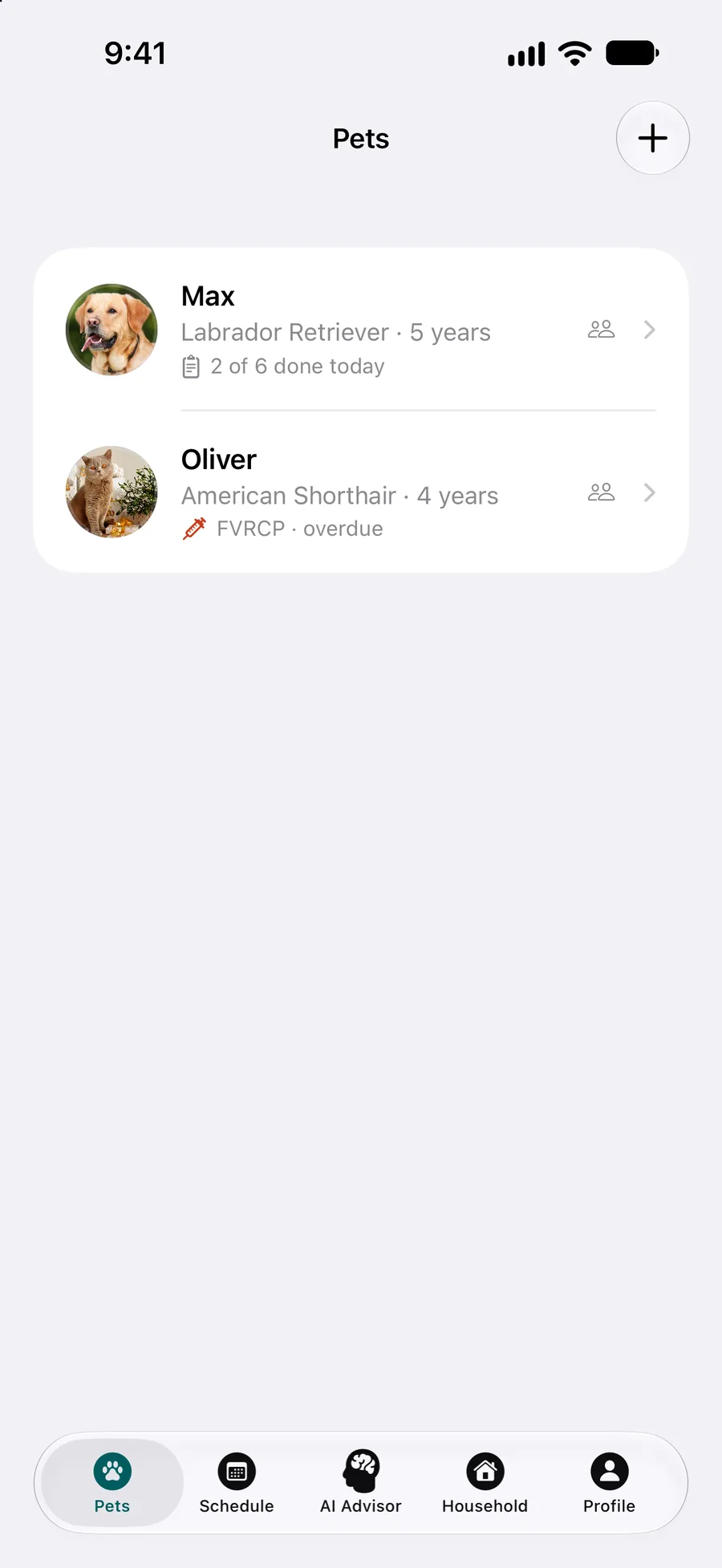
See all Pettify features. Pettify costs $4.99 a month, or $49.99 a year with a 7-day free trial first.
Frequently asked questions
Can all my pets eat the same food?
Often not. Tufts' Petfoodology team notes that dog food doesn't have all the nutrients cats need, and a veterinary diet for one pet may not meet the needs of the others. In some cases, especially with healthy pets, one diet can suit all the dogs or all the cats in a home. Ask your vet before you switch anyone to a shared food.
What if my pets see different vets?
Write the clinic name and phone number in each pet's row, not once at the top of the page. A sitter who needs help for the cat should find the cat's clinic next to the cat. Keep each clinic's paperwork in that pet's own folder, and note which clinic gave which vaccine, so a new vet can ask the right place for the history.
Do I need a separate carrier for each pet?
If you can, yes. Ready.gov's pet emergency kit list includes a traveling bag, crate or sturdy carrier, ideally one for each pet. One carrier per pet means you can move every pet at the same time. Put the pet's name on each carrier, and keep copies of that pet's documents in a waterproof container and on your phone.
What should I do if one pet eats another pet's medicine?
Call your veterinarian or an animal poison control center: that is the FDA's advice whenever a pet gets into a medicine. ASPCA Animal Poison Control answers 24 hours a day, 365 days a year at (888) 426-4435, and a consultation fee may apply. The FDA also lists the Pet Poison Helpline, 855-764-7661.
Sources
- Petfoodology, Cummings School of Veterinary Medicine at Tufts University. Managing Multi-pet Mealtimes. 2016. sites.tufts.edu (opens in a new tab) (accessed )
- U.S. Food and Drug Administration. Properly Store Medications to Keep Your Pet Safe. 2024. fda.gov (opens in a new tab) (accessed )
- ASPCA. ASPCA Poison Control. aspca.org (opens in a new tab) (accessed )
- Humane World for Animals. How to Introduce New Cats to Your Home. humaneworld.org (opens in a new tab) (accessed )
- RSPCA. Introducing your cat to other people and pets. rspca.org.uk (opens in a new tab) (accessed )
- Ready.gov, U.S. Department of Homeland Security. Prepare Your Pets for Disasters. 2026. ready.gov (opens in a new tab) (accessed )