Dog Chore Chart for Kids: Age-by-Age Pet Responsibilities

By Pettify Team
Published 7 min read
A dog chore chart for kids gives each child jobs that fit their age. Kids of 2 to 4 can scoop food and refill water with an adult in the room, 5- to 9-year-olds can be the main feeder, and from about 10 most daily care is in reach. An adult stays responsible for the dog at every age.

Key takeaways
- Match each dog chore to the child's age: small kids help with food and water, and tweens can handle most daily care.
- An adult stays responsible for the dog at every age and keeps vet visits and medicines off the kids' side of the chart.
- Never leave a baby or small child alone with a dog, and teach kids to leave a dog alone while it eats or sleeps.
- Every dog chore ends with soap and water, and an adult watches young children wash their hands.
- Give each child's job a time window, an adult backup and one place to mark it done.
On this page
A dog chore chart for kids by age
A dog chore chart for kids works when every job fits what the child can do safely and an adult stays in the loop at every age. The table below brings together age guidance from the American Kennel Club (AKC), the Texas A&M veterinary college, Samaritan Health Services and the American Academy of Child and Adolescent Psychiatry (AACAP).
Copy the rows that fit your family onto paper or a whiteboard. If adults share the dog's care too, our shared pet care schedule shows how to add times and a backup to every task.
| Age | Jobs they can do | How much help | Keep with an adult |
|---|---|---|---|
| 2–4 | Scoop dry food into the bowl, refill the water bowl, brush with a soft brush, put toys away, toss a ball | An adult in the room for every job, never alone with the dog | Walks, poop pickup |
| 5–9 | Be the main person who feeds the dog, wipe up spilled food and water, play outside if the dog's size allows, pick up poop | An adult checks each job and watches handwashing | Walks, vet visits, medicines |
| 10–12 | Most daily care: feeding, play, exercise, potty breaks, grooming | Walks with an adult supervising, help with a schedule | Vet visits, medicines |
| 13+ | All of the above, plus walks if they can keep safe control of the dog | An adult still oversees the dog's care | Vet visits, medicines |
How the rows break down:
- Ages 2–4. Dr. Sara Griffin, a lecturer at the Texas A&M veterinary college, says children as young as two can help feed a pet but should never be left alone with one. The AKC adds that 3- and 4-year-olds can scoop food, refill water bowls, brush with a soft brush and put toys away, still supervised. Samaritan Health Services suggests tossing a ball to exercise the dog.
- Ages 5–9. The AKC says kids this age can become the main person who feeds the dog and can clean up spilled food and water around the bowls. Whether they can take the dog outside to play depends on the dog's size and your living situation.
- Ages 10–12. The AKC describes tweens as capable of most day-to-day care: feeding, play, exercise, potty duty and grooming. Dr. Griffin says children around 10 should be able to walk, feed and clean up after a pet, but still need adult supervision.
- Teens. Samaritan Health Services adds dog walking for teenagers who can maintain safe control of the dog.
Treat the ages as a guide, not a rule. A calm small dog and a strong, excitable large dog are different jobs for the same child.
Why an adult stays responsible for the dog
Kids can own chores, but they can't own the dog. AACAP says children under 10 can't care for a dog on their own, and that parents must oversee a pet's care even when they believe their child is old enough.
The AKC puts it just as plainly: whatever was agreed before the dog came home, the adults end up responsible for everything, including scheduling and driving to vet appointments. Medicines sit on the adult side of our chart for the same reason. Dose and timing come from your vet, and one adult should give or check every dose.
On the chart, that means every child's job has an adult backup who checks it got done. If a child forgets, the dog still eats on time because the backup steps in. Children learn responsible pet ownership by watching their parents, AACAP notes, so mark your own jobs on the same chart.
Safety rules for kids doing dog chores
Supervision is the main safety rule. The AVMA says to always supervise young children around dogs, however well behaved the child and the dog are, and never to leave a baby or small child alone with a dog. About half of dog bite victims are children, according to the AVMA.
Build these rules into the chores themselves:
- Put the bowl down and step away. The AVMA advises never disturbing a dog that is eating, sleeping or caring for puppies. Whoever fills the bowl leaves the dog to eat in peace.
- Choose calm games. The AVMA recommends avoiding highly excitable games like wrestling or tug-of-war, which can increase the risk of a nip or a bite. A ball to toss makes a better play job.
- Match the leash to the dog. The AVMA says to use a leash in public to keep control of your dog. A child only holds the leash of a dog they can control, with an adult alongside until you're sure.
- Teach respect early. The AVMA advises teaching children, toddlers included, to be careful around pets and respectful of them.
Watch the dog as well as the child. The AVMA notes that dogs in pain are more likely to bite, and that a dog that seems uneasy should be removed from the situation.
Handwashing after every dog chore
Every dog chore ends at the sink. The CDC advises washing children's hands thoroughly with soap and water right after they touch, feed or care for animals, and says adults should supervise handwashing for young children.
The youngest helpers need the closest watch. The CDC says children under 5 are more likely to get sick from germs animals can carry: they often touch surfaces that may be contaminated with animal poop and are more likely to put their hands in their mouths. Their immune systems are still developing too, so an illness can be more serious. That's why poop pickup stays off the chart for kids under 5.
Once a child is old enough to pick up after the dog, the AKC's advice is to teach proper hygiene and make sure they wash their hands. Samaritan Health Services also suggests reminding children about hygiene after pet chores.
How to set up and track a dog chores list
A dog chores list works when every job has a name, a time and a place to mark it done. Start with a few jobs and add more as your child shows they can do them.
- List the dog's daily and weekly jobs: meals, fresh water, walks, play, brushing, poop pickup and putting toys away.
- Give each child one or two jobs from their row in the age table.
- Write an adult backup next to every child's job.
- Give each job a time window, such as "after school, 3:30–4:00 pm", so everyone knows when it's late.
- Mark the job done right after it's finished, with initials and the time.
- Look at the chart once a week and add a new job only when the current ones get done without reminders.
For kids 10 and older, the AKC article suggests helping them set a schedule so they keep up with the chores they agreed to. For younger children, hang the chart where the job happens, next to the food bin or on the fridge.
With more than one pet, add a column for each one, so "fed the dog" never hides an unfed cat. Our guide to running a multi-pet household shows how to lay out a table for several pets.
Tracking dog chores together in Pettify
Pettify is a pet diary and care plan app for iPhone, iPad, Mac and Apple Vision Pro that the whole family can share. The chart still decides whose job is whose; Pettify keeps the record of what got done.
- Invite the family, kids included. Invite family by email or QR code, and choose who can edit and who can only view. A child or teen with their own device can join like anyone else, so the chores they tick off show up for everyone.
- Today's care in one list. The care plan shows today's tasks, such as feeding, walks and grooming, and you tick each one off when it's done.
- No double meals. Once a task is ticked off on one phone, its reminder stays quiet on the others. Everyone gets a notification when someone else logs care.
- Reminders on repeat. Set them daily, several times a day if needed, or weekly, monthly or yearly.
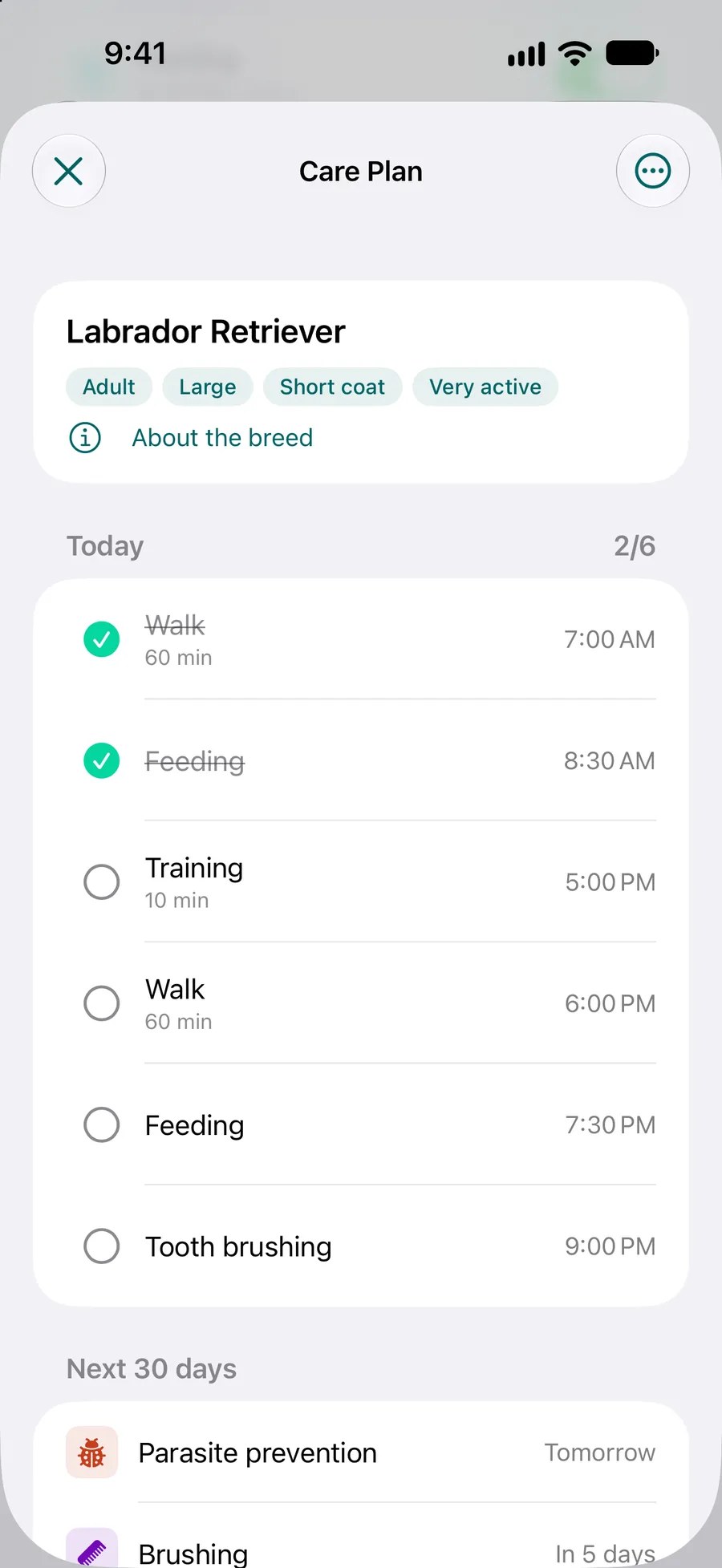
Younger kids without a device of their own can tick the task off together with you on your phone, right after the job. See all Pettify features. Pettify costs $4.99 a month, or $49.99 a year with a 7-day free trial (US App Store prices). There is no free tier.
When to change the dog chore chart
Review the chart whenever your family or your dog changes. Some changes need more than a new name in a box.
- A new puppy. Kids can help with house-training, but the AKC notes that it takes a degree of consistency most kids don't have. An adult owns it.
- A new baby or a new dog. The AVMA advises carefully managing introductions of children or a new dog to your household. Expect the adults to take more of the chart for a while.
- A dog that seems uneasy. Keep children off that dog's jobs until you know why. If its fear or aggression seems unprovoked or excessive, the AVMA advises seeing a vet.
- A child who's ready for more. Move up one job at a time, and keep the adult backup in place.
Frequently asked questions
What age is best to get a dog for a child?
The AVMA suggests considering waiting until your children are older than 4 years before adopting a new dog, and carefully managing introductions of children or a new dog to the household. Plan for an adult to do most of the care for years after that: the American Academy of Child and Adolescent Psychiatry says children under 10 can't care for a dog on their own.
What should you do if your child stops doing their dog chores?
The dog's needs come first, so the adult backup does the job that day. Then talk to your child. The American Academy of Child and Adolescent Psychiatry suggests reminding children in a gentle, not scolding way that animals, like people, need food, water and exercise. If a child stays lax, it says, parents may have to take over the care themselves.
How can kids tell that a dog wants to be left alone?
The AVMA says a worried dog may yawn, put its ears back or raise a paw. A dog that tucks its tail, or stiffens its body and stares, may feel frightened or threatened, and growling, snapping or biting means it wants to be left alone right now. A simple rule for kids, based on the AVMA's advice: if a dog turns or walks away, let it go and leave it alone.
How should kids greet a dog they don't know?
On walks, kids will meet other people's dogs. The AVMA advises teaching children not to approach strange dogs, to ask the owner's permission before petting any dog, and never to reach through a fence to pet one. Once the owner says yes, a child should approach slowly and calmly without looming over the dog. Kids shouldn't run past a dog, and if a dog comes up to sniff them, they should stay still.
Sources
- American Veterinary Medical Association (AVMA). Preventing dog bites. avma.org (opens in a new tab) (accessed )
- Centers for Disease Control and Prevention (CDC). People at Increased Risk for Illness from Animals. 2025. cdc.gov (opens in a new tab) (accessed )
- American Academy of Child and Adolescent Psychiatry. Pets and Children (Facts for Families No. 75). 2026. aacap.org (opens in a new tab) (accessed )
- American Kennel Club. How to Know if Your Child Is Ready for a Dog. 2025. akc.org (opens in a new tab) (accessed )
- Texas A&M College of Veterinary Medicine & Biomedical Sciences. Pets: A Positive Impact on Kids. 2016. vetmed.tamu.edu (opens in a new tab) (accessed )
- Samaritan Health Services. Age Matters With Kids & Pet Chores. 2022. samhealth.org (opens in a new tab) (accessed )