Shared Pet Care Schedule: How Families Split Feeding, Walks and Meds

By Pettify Team
Published 9 min read
A family pet care schedule is a table that names who does each task, what the task is and when it's due. Choose one way to split the work, by time of day, by area or by turns, and keep one check-off point everyone can see. Food amounts, exercise needs and medicine doses come from your vet.

Key takeaways
- Write the schedule as who, what and when, with one named person per task and a named backup for the days that person is away.
- Split the work by time of day, by area of responsibility or by turns. Each model breaks in a different place, so pick the one that fits your week.
- Keep one check-off point that everyone can see, and mark a task done right after you do it, with the time and your initials.
- Give each medicine one owner and one log, and write down what your vet says to do about a missed or extra dose.
- Children can help with pet care from a young age, but an adult supervises and stays the backup for every task a child owns.
On this page
A pet care schedule template: who, what and when
A pet care schedule only works when every task has a name next to it. "Someone feeds the dog in the morning" usually means each person assumes another one did it. Copy the structure below to a sheet of paper, a shared note or a spreadsheet, then replace the roles with real names.
| Task | When | Who | Backup | Marked done |
|---|---|---|---|---|
| Breakfast | 7:00–7:30 am | Adult 1 | Teen | Initials and time on the sheet |
| Morning walk | Before 8:00 am | Teen | Adult 1 | Initials and time |
| Fresh water, wash bowls | Morning | Child, with an adult | Adult 2 | Tick |
| Dinner | 6:00–6:30 pm | Adult 2 | Adult 1 | Initials and time |
| Evening walk | 8:00–9:00 pm | Adult 1 | Adult 2 | Initials and time |
| Medicine, if prescribed | As the vet's label says | Adult 2 | Adult 1 | Medication log |
| Brushing | Sunday | Teen | Adult 2 | Tick |
| Vet visits, refills, records | As due | Adult 2 | Adult 1 | Calendar entry |
Use a time window, not a single minute. "6:00–6:30 pm" tells everyone when a task is late, and late is the moment the backup steps in.
If you would rather print it, the weekly pet care schedule template has a row for each task, a box for each day and Who and Backup columns, in Letter and A4.
The number of rows depends on your pet. The ASPCA's feeding guidance for dogs is four meals a day for puppies 8 to 12 weeks old, three meals from 3 to 6 months and two meals from 6 months to 1 year. After the first birthday, one meal a day is usually enough, though some dogs, including larger ones, do better on two smaller meals. Ask your vet which fits your dog, and how much goes in the bowl.
Walk rows vary too. The RSPCA advises taking a dog out at least once a day unless your vet recommends otherwise, and the ASPCA notes that exercise needs depend on breed or breed mix, sex, age and health. Water gets its own row because both organizations say it should always be available: the ASPCA adds that food and water dishes should be washed frequently.
Tip
Fill in the Backup column before anything else. The first real test of any schedule is the day the named person has a late meeting or a sleepover, and a named backup means nobody has to ask around.
Three ways to split pet care in a family
Shared pet care can be split in three basic ways. Each breaks in a predictable place, so pick the one that matches how your week really looks, not how you wish it looked.
By time of day
One person owns the mornings and another owns the evenings. The early riser handles breakfast and the morning walk; whoever gets home first handles dinner and the evening walk.
- Works well: it is easy to remember, it follows work and school hours, and each slot has exactly one owner.
- Breaks when: weekends, shift changes or a business trip leave half the day without an owner. The person with the longer slot can also end up doing more than half the work without anyone noticing.
By area of responsibility
One person owns feeding, another owns walks, and a third owns grooming, vet visits and refills.
- Works well: each person gets good at their area. The feeder knows the amounts and notices when the food is running low; the admin owner knows when the next vet visit is due.
- Breaks when: the load is uneven. Walks happen every day, while vet admin comes up a few times a year. Tasks between areas, such as buying food or cleaning up after a walk, belong to nobody until you name an owner.
By turns: alternating days or weeks
One person is on duty for the whole day or the whole week, then hands over to the next.
- Works well: the split is fair and easy to see, swaps are simple, and everyone learns every task. That last point matters when someone is sick or away.
- Breaks when: handover days are where tasks get missed or doubled. The person coming off duty has to pass on what the next one should know, so this model needs a shared record more than the others.
| Model | Fits | Main risk | Fix |
|---|---|---|---|
| Time of day | Stable work and school hours | Weekends and shift changes | A separate weekend row |
| Area of responsibility | Families with teens; one person handles the vet | Uneven load, tasks between areas | Name an owner for every leftover task |
| Turns | Roommates, households with changing hours | Handover days | A written handover note |
Whichever model you pick, agree on the rules as well as the names. The RSPCA asks owners to be consistent in the way they, their family and their friends react to their dog. The same idea applies to the schedule: the same amount in the bowl, the same treat rule and the same walk routine, whoever is on duty.
Who fed the dog? One check-off point everyone can see
Double feeding happens when the record of a task lives in one person's head. The fix is a single check-off point, marked straight after the task and visible to everyone in the house.
- Pick one place. A sheet on the fridge or next to the food bin, or one shared app. Not both, because two records soon disagree.
- Check before you act. Look at the sheet before you fill the bowl, not after.
- Mark it right away. Write your initials and the time as soon as the bowl is down or the leash is back on the hook.
- Write the time, not only a tick. "7:10, AB" settles the question; a tick doesn't say which day it was for.
- Keep one measuring scoop with the food. The RSPCA advises giving the right amount so a dog doesn't become under or overweight, and a repeated extra meal makes that hard.
- Decide who gives treats. Or log treats on the same sheet, so they don't pile up across three people.
Paper has one weak spot: it only works for people who are standing next to it. If you're at work and want to know whether the evening walk happened, the fridge can't tell you. A shared app fixes that. In Pettify, everyone gets a notification when someone else logs care, and once a task is ticked off on one phone, its reminder stays quiet on the others, so the dog gets fed once, not twice.
Which pet care tasks can kids do?
Children can share pet care early, but adults stay in charge. In a 2016 Texas A&M article, Dr. Sara Griffin of the university's College of Veterinary Medicine said children as young as two can help feed a pet but should never be left alone with one. Around age 10, she said, children should be able to walk, feed and clean up after a pet, but still need adult supervision.
In the template, that means two things:
- Younger children get supervised jobs: scooping food into the bowl while an adult watches, or carrying the water bowl to its spot.
- Older children can own a row, such as the morning walk, but an adult is always in the Backup column and checks that the task was marked done.
Match the walk to the dog, too. A child should only hold the leash of a dog they can physically control.
Medications: one person, one log
Medicine needs the strictest rules on the schedule. Give each medicine one owner per dose, and let the backup step in only after checking the log.
The dose, timing and length of the course come from your vet, not from the schedule. The FDA suggests asking your vet how often to give the medicine and how much each time, whether to give it with food, and what to do if you forget a dose or accidentally give too much. Write the answers on the schedule, so whoever is on duty doesn't have to guess. The ASPCA also warns never to give a dog medication that a veterinarian hasn't prescribed.
For a paper record, the printable pet medication log has a prescriptions table and a dose log with the date, time, medicine, dose, who gave it and notes. Keep it next to the medicine, so the next person sees the last entry first.
Important
If someone gave an extra dose or too much medicine, the FDA's advice is to call your vet right away. If your pet got into medicine or something poisonous, ASPCA Poison Control answers 24/7 at (888) 426-4435. A consultation fee may apply.
Going away: hand the schedule to a sitter
The schedule you already have is most of a sitter's instructions. When you travel, the Who column gets the sitter's name, the Backup column gets a neighbor or relative who can step in, and every row keeps its time window and its check-off method.
Add what a stranger to your home doesn't know: your phone numbers, your vet and the nearest 24-hour clinic, where the food and leash are kept, and the house rules your family agreed on. Our guide on what to leave for a pet sitter covers the full list. To turn it into a sheet the sitter can stick on the fridge, use the pet sitter instructions template: you fill in contacts, the vet, feeding, medicines and the daily routine, then print it or save it as a PDF.
Walk through one feeding and one walk with the sitter before you leave. It shows them where everything is, and it shows you whether your schedule makes sense to someone outside the family.
More than one pet in the house
With two or more pets, add a Pet column to the template, or keep one row per pet for every meal. "Fed the pets" doesn't tell anyone whether the cat got her dinner or which bowl held which food.
Write the food, the amount and the bowl for each pet on the schedule, so nobody has to guess which bowl belongs to whom. If each pet has its own routine, it can help to give each pet one owner and keep a shared backup. Our guide to running a multi-pet household goes deeper into keeping track of several pets at once.
In Pettify, the pet list shows the next thing for each pet, such as today's care task or a vaccination due within a month, and marks overdue items in red.
How Pettify runs a shared pet care schedule
Pettify is a pet diary and care plan app for iPhone, iPad, Mac and Apple Vision Pro that the whole family can share.
- Invite the household. Invite family by email or QR code, and choose who can edit and who can only view.
- One plan for everyone. Everyone sees the same diary and care plan, including what's due today.
- Know when it's done. You get a notification when someone else logs care. Once a task is ticked off on one phone, its reminder stays quiet on the others.
- Reminders. Set them once or on repeat for feeding, grooming, medicines and vet visits.
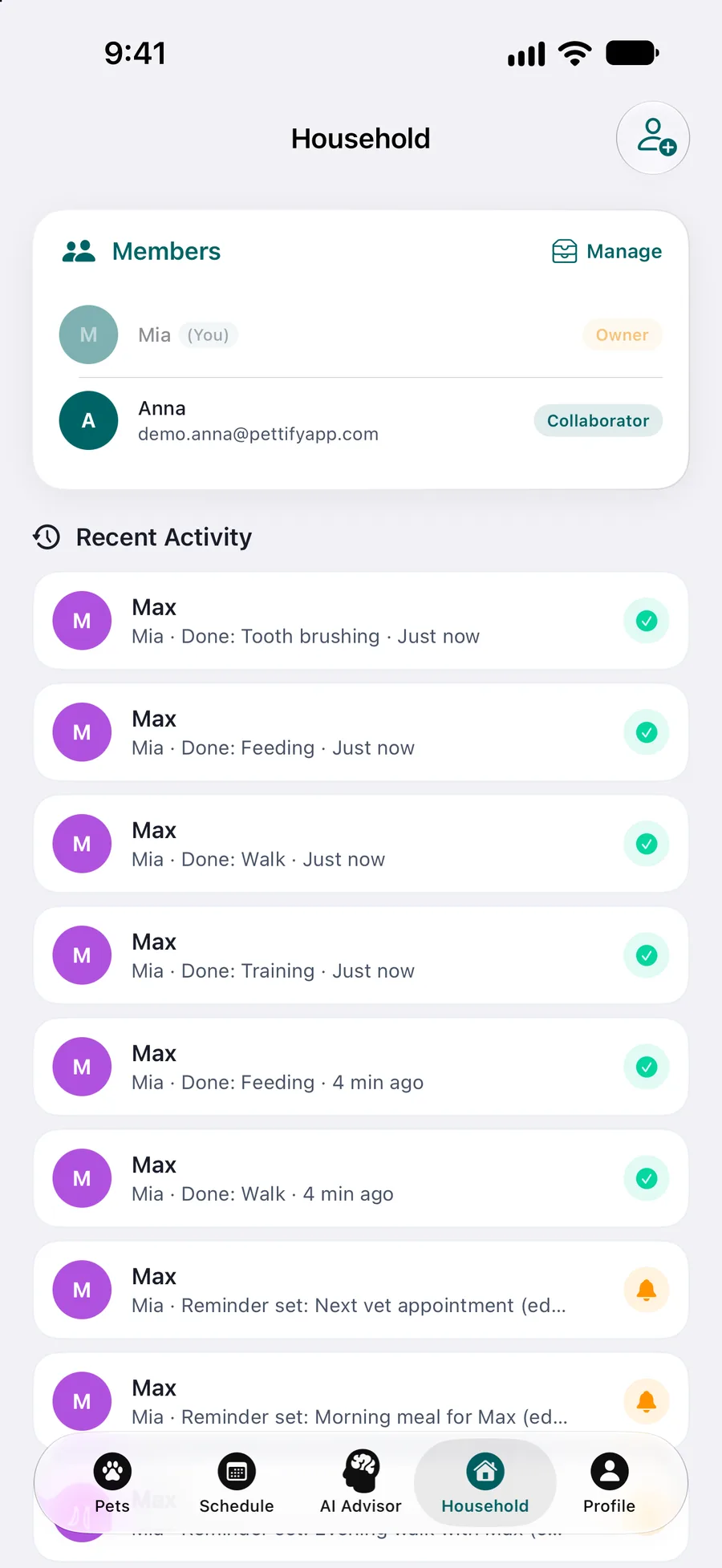
The Who column is still a family decision; the app shows what's done and who did it. See all Pettify features. Pettify costs $4.99 a month, or $49.99 a year with a 7-day free trial first (US App Store prices). There is no free tier.
Frequently asked questions
Is a paper chart or an app better for a family pet care schedule?
Paper works for a small household where everyone passes the same spot every day, such as the fridge or the food bin. It fails when someone is out and needs to know whether the dog was fed, or forgets to walk back to the sheet. A shared app covers those cases. Whichever you choose, use only one, because two records drift apart.
How often should you update a pet care schedule?
Update it whenever the household's week changes: a new school year, a new job, a new shift pattern or a new pet. Puppies need updates more often, because the ASPCA's feeding guidance changes the number of meals at about 3 months, 6 months and 1 year. A quick monthly check that the names still match reality catches most problems.
Does a cat need a care schedule too?
Yes, if more than one person looks after the cat. The structure is the same: task, time, owner and backup. Walks drop out, and litter box cleaning and play sessions take their place. Ask your vet how much and how often to feed your cat, then write those answers into the schedule so everyone uses the same amounts.
What if one person ends up doing most of the pet care?
Write down what actually happened for one ordinary week, task by task, and count. A real count is easier to discuss than a feeling. Then move whole tasks, not halves: give someone the evening walk every day rather than every other Tuesday. Switching to the turns model for a month also shows everyone how much work each task takes.
Sources
- ASPCA. General Dog Care. aspca.org (opens in a new tab) (accessed )
- RSPCA. How to help your dog behave well. rspca.org.uk (opens in a new tab) (accessed )
- RSPCA. A healthy diet for dogs. rspca.org.uk (opens in a new tab) (accessed )
- Texas A&M College of Veterinary Medicine & Biomedical Sciences. Pets: A Positive Impact on Kids. 2016. vetmed.tamu.edu (opens in a new tab) (accessed )
- U.S. Food and Drug Administration. Medications for Your Pet: Questions for Your Vet. 2024. fda.gov (opens in a new tab) (accessed )
- ASPCA. ASPCA Poison Control. aspca.org (opens in a new tab) (accessed )