Dog Boarding Checklist: What to Pack and What to Tell the Kennel

By Pettify Team
Published 9 min read
A dog boarding checklist has three parts: what to pack, what to tell the kennel and which documents to bring. Pack your dog's usual food with extra, medicines in their labeled packaging and something that smells of home. Write down feeding, medicines, health and contacts, and bring written proof of vaccinations. Confirm the kennel's own list first.

Key takeaways
- Pack your dog's usual food plus extra for a late return, medicines in their original labeled packaging, an ID tag and a worn T-shirt.
- Give the kennel a written sheet: meals, medicines, health issues, behavior, your vet, a local emergency contact and how to reach you.
- Kennels commonly ask for written proof of vaccinations. Confirm the list with your kennel and ask your vet what your dog needs.
- Tour the kennel before you book, and ask who watches the dogs, how play groups are formed and what happens in an emergency.
On this page
The dog boarding checklist at a glance
A dog boarding checklist covers three jobs: what goes in the bag, what the kennel needs to know, and the papers it checks at drop-off. Ask the kennel for its own list before you pack. The American Kennel Club (AKC) says the facility should tell you what to bring before drop-off.
| Pack | Tell the kennel (in writing) | Documents |
|---|---|---|
| Your dog's usual food, plus extra | Food, amounts and meal times | Written proof of vaccinations from your vet |
| Medicines in their original labeled packaging | Each medicine, dose and time | The kennel's medication form, if it has one |
| Collar with an ID tag | Health issues and behavior | The kennel's service agreement or booking form |
| A worn T-shirt or blanket | Your vet's name and number | Your dog's microchip number |
| A favorite toy and long-lasting chews | A local emergency contact | A printed copy of your instructions |
| Bed, if your dog sleeps in one | How to reach you, and your return date |
Tip
Write the instructions once. Our free pet sitter instructions generator prints your contacts, your vet and the nearest 24-hour clinic, food, medicines and the daily routine on one sheet. For a kennel, skip the optional home section and hand the sheet over at drop-off. What you type stays in your browser.
If your family already splits feeding and walks on a shared pet care schedule, copy the daily part of it for the kennel: meal times, amounts and the medicine plan.
What to pack for dog boarding
Pack the things that keep your dog's days close to normal: the usual food, any medicines and a few items that smell of home. The AKC's packing list for a boarding stay starts with identification and ends with extra food in case your trip runs long.
| What to take | How much | Why |
|---|---|---|
| Your dog's usual food | Daily amount × nights away, plus extra | A sudden change in diet can upset your dog's stomach (AKC). The extra covers a late return |
| Medicines and supplements | Every dose for the stay | Some kennels accept medicine only in its original labeled packaging (see below) |
| Collar with an ID tag | One, worn at drop-off | The AKC suggests a tag and a microchip, both with your dog's name, your name, phone number and address |
| A worn T-shirt or blanket | One | It carries the smell of your household and can soothe a stressed or homesick dog (AKC) |
| Favorite toys and long-lasting chews | A few | They keep your dog busy and may encourage play (AKC) |
| Bed | Only if your dog sleeps in one | The AKC lists it among things you may bring; check that the kennel allows it |
Some kennels have their own food, but the AKC recommends bringing your dog's usual food, because a sudden switch is hard on a dog that is already stressed. At PetSmart's PetsHotel, for example, food you bring is fed at no charge, and its in-house brand costs extra.
What to tell the kennel
Write down everything you would explain at the door, so every staff member who looks after your dog reads the same instructions. Humane World for Animals puts the same notes in its pet disaster kit: written information about your pet's feeding schedule, medical conditions and behavior, with your vet's name and number, in case you have to board your pet.
Meals and routine
- Food and amounts. Write the food, the amount per meal and the meal times. The AKC expects a good kennel to feed dogs on a regular schedule with portions suited to their size and weight, so give the staff exact numbers.
- Treats and rituals. If your dog gets a certain treat at the same time every day, the AKC suggests asking the kennel to keep doing it.
- Off-limits food. Say what your dog must not eat, and whether it may have treats from the staff.
Health and behavior
- Health conditions. Explain how a condition changes the day. The AKC's example is a dog with arthritis that needs frequent play breaks and joint supplements at meals.
- Behavior. The AKC advises being open about separation anxiety, resource guarding or an illness that needs close monitoring, and discussing it before you book.
- Other dogs. Some kennels group dogs for play by compatibility, age and energy level, as the AKC describes. Say if your dog prefers to be alone.
Contacts
- You. A phone number that works on your trip, and your return date. The San Francisco SPCA says that if your dog doesn't eat for a few days or seems off, the kennel should contact you and let you decide how to proceed, so give a number you'll answer.
- A local contact. The AKC suggests a friend or family member in the area who knows your dog and can help in an emergency.
- Your vet and emergency clinics. Your vet has your dog's records and can refer the kennel to an emergency facility. The AKC also suggests listing the emergency clinics you know nearby.
Medicines: original packaging and written instructions
Bring each medicine in the packaging your vet or pharmacy gave you, with the label intact, and write the instructions out as well. PetSmart's PetsHotel, for example, says all medication must be in its original packaging and clearly labeled with the type of medication and dosage. It accepts over-the-counter products only with a vet's dosage recommendation, doesn't give injections, and asks you to call ahead to check that it can give your dog's medicine.
For each medicine and supplement, write down:
- the name, exactly as it's printed on the label;
- the dose, copied from the vet's label;
- the times of day it's due;
- how you give it, such as in a treat;
- what to do about a missed dose (ask your vet before you leave).
If the kennel doesn't have its own form, a printable pet medication log lists each medicine with its dose and how often it's given, and has a log for every dose. Count the doses against the nights you'll be away, and ask your vet about a refill early if you'll run short.
Important
Don't move medicines into an unlabeled pill box for a kennel stay. Staff can't check what's inside, and kennels such as PetsHotel accept only original labeled packaging.
Dog boarding requirements: vaccines and documents
Kennels commonly ask for written proof that your dog's vaccinations are current. The American Veterinary Medical Association (AVMA) notes that reputable boarding, daycare, grooming and training services require up-to-date vaccinations. The AKC says many states require a kennel to have proof of dogs' vaccination records to operate, and it warns you to be wary of a kennel that doesn't require immunization records.
Which vaccines a kennel asks for varies. As one example, PetSmart's PetsHotel lists rabies, the DAPP/DHPP combination and Bordetella as required, recommends canine influenza and leptospirosis vaccines without requiring them, and also asks for proof that your dog meets state and local boarding vaccination rules. The AVMA lists Bordetella and canine influenza among the vaccines recommended for dogs that go where other dogs gather, including boarding. Confirm the list with your kennel when you book, and ask your vet which vaccines your dog needs and when to get them.
What to have ready:
- Vaccination records from your vet clinic. Some kennels can get them from the clinic: PetsHotel has a release form your vet fills in and faxes to them.
- ID details. Your dog's microchip number, with your contact information up to date.
- Flea and tick rules. PetsHotel turns away dogs with signs of fleas or ticks. Ask your kennel about its rule and your vet about prevention.
- The kennel's forms. A service agreement and a medication form, filled in before drop-off.
To keep the dates in one place, fill in a pet vaccination record after each vet visit. Bring the paperwork your vet signed as well: your own record is a summary, not a certificate.
Questions to ask a kennel before you book
Visit before you book, and ask to see every area your dog will use. The AKC says a reputable kennel lets you see the dog runs, where meals are prepared and where dogs play, and that you should walk away if you can't view the entire facility. The San Francisco SPCA's checklist adds what a good answer sounds like.
| Topic | What to ask | A good answer |
|---|---|---|
| The visit | Can I tour every area my dog will use? | Yes (SF SPCA, AKC) |
| Staff | Are attendants with the dogs 24 hours a day? What training do they have? | Yes; at least a few weeks of intensive training in animal care, behavior, basic medical triage and CPR (SF SPCA) |
| Play groups | How are dogs grouped, and how many dogs per attendant? | By age, size and energy level; ideally one person per seven small dogs or per five large dogs (SF SPCA) |
| Daily routine | What does a day look like for my dog? | At least three potty breaks, one-on-one time with people, play if suitable (SF SPCA) |
| Emergencies | What happens in a medical emergency? Is there a vet on staff? | A partnership with a nearby 24-hour vet, and willingness to use your own vet (SF SPCA); without a vet on staff, ties to local vets (AKC) |
| Illness | How do you keep the dogs healthy? | Regular cleaning of crates and play areas, and separating dogs with worrying symptoms (AKC) |
| Vaccines | Do all boarders have to be current on vaccines, including Bordetella? | Yes. The AKC warns about kennels that don't require vaccination records |
| License | Does the state inspect boarding kennels here? | If it does, a license or certificate on display (SF SPCA) |
Ask about a trial stay too. The AKC notes that many kennels offer test runs and some require them, to see how a dog handles the place, its temperament and whether it plays well with others.
Dog boarding vs a pet sitter
A boarding kennel looks after your dog at its facility, and a pet sitter looks after your dog at home. The AKC notes that with a sitter you don't drop your dog off or worry about run-ins with other dogs, and that you'd ask a sitter many of the same questions you ask a kennel.
| Boarding kennel | Pet sitter | |
|---|---|---|
| Where your dog stays | At the kennel | At home |
| Other dogs | Regular play with other dogs, unless yours prefers to be alone (AKC) | Only your own pets |
| What you prepare | A packed bag and a written sheet | Supplies at home and written instructions |
| Supervision | Ask whether attendants are on site 24 hours (SF SPCA) | Agree on visit times or an overnight stay |
If a sitter suits your dog better, our guide to what to leave for your pet sitter covers the instructions, supplies and emergency plan.
Keep boarding papers ready with Pettify
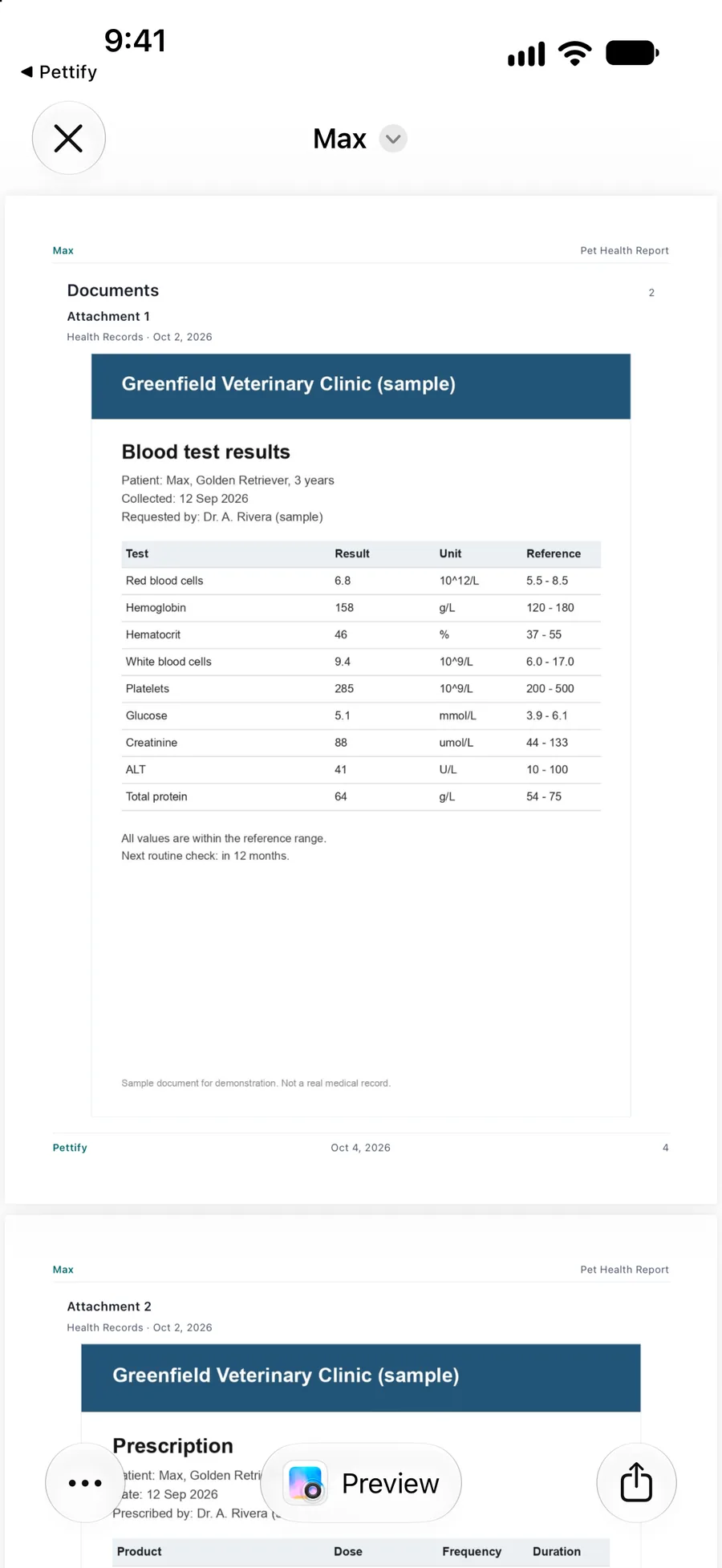
A kennel stay needs the same papers each time: vaccinations, medicines and your vet's details. Pettify, our app for iPhone, iPad, Mac and Apple Vision Pro, keeps a record of your pet's vaccinations and vet visits, with the medicines prescribed at each visit. From your pet's profile you can export a PDF report with basic details, vaccinations, vet visits, health records, the care plan and recent activity, and any lab results or scans you attached are printed inside, and share it with the kennel straight from the app. Once a vaccination has a next date, Pettify reminds you 7, 3 and 1 day before it's due, as long as notifications are allowed. Read more about the vaccination tracker.
The report is your own summary, so bring the certificate your vet signed too. Pettify costs $4.99 a month, or $49.99 a year with a 7-day free trial (US App Store prices).
Frequently asked questions
Can I call or visit my dog while it's at a boarding kennel?
Ask before you book, because policies differ. The San Francisco SPCA's checklist for choosing a boarding facility suggests asking when you may call to check on your dog and during what hours you may visit. The answer it hopes for in both cases is any time the facility is open. Agree on how you'll get updates, too.
What happens if I get back later than planned?
Ask about it when you book. The San Francisco SPCA suggests asking a kennel what happens if your return is delayed, and hopes the facility will arrange an after-hours pickup with reasonable notice. The AKC recommends packing extra food in case travel plans change and the stay runs longer. Call the kennel as soon as you know you'll be late.
How can I tell if my dog did well at the kennel?
Look at your dog when you pick it up, especially after a first trial stay. The AKC's good signs include a dog tired from play, one that lingers to say goodbye to a caregiver, no signs of distress such as heavy panting, drooling or a stiff body, no bruises, cuts or scratches, and paws free of dried urine or feces.
Will my dog be stressed at a boarding kennel?
It depends on the dog. The AKC notes that some dogs enjoy the playtime, new smells and change of scenery, while others show signs of stress and shy away from staff and other dogs. A trial run shows you which kind your dog is. A worn T-shirt or blanket from home may help a homesick dog settle.
Sources
- American Veterinary Medical Association. Vaccinating your pet. avma.org (opens in a new tab) (accessed )
- American Kennel Club. What to Know and Look for When Boarding Your Dog. 2025. akc.org (opens in a new tab) (accessed )
- American Kennel Club. What to Pack When You Board Your Dog. 2025. akc.org (opens in a new tab) (accessed )
- San Francisco SPCA. Selecting a Boarding Facility (PDF). sfspca.org (opens in a new tab) (accessed )
- Humane World for Animals. Pet emergency plan and disaster preparedness. humaneworld.org (opens in a new tab) (accessed )
- PetSmart. PetsHotel Required Vaccinations & Forms for Boarding. services.petsmart.com (opens in a new tab) (accessed )