Moving With Pets: Records, New Vet and State Rules Checklist

By Pettify Team
Published 10 min read
Moving with pets is easier on a countdown that starts about eight weeks out, or sooner for a move abroad. Check your destination's pet rules, get copies of your pet's records and line up a new vet. On moving day, keep your pet in a quiet room or with a friend, then update the microchip registry once you arrive.

Key takeaways
- Your destination state or country sets the pet rules. USDA APHIS lists them by state and by country; check before you book anything.
- Ask your current vet for copies of your pet's records, and have them sent to the new clinic once you choose it.
- On moving day, keep your pet in a quiet room with the door shut or at a friend's house, and travel in a secured crate.
- Update the microchip registry and the ID tag as soon as you move. A microchip doesn't replace a collar tag.
- In the new home, start with one home-base room and open up the rest of the house gradually.
On this page
Moving with pets: the 8-week checklist
Moving with pets works best as a countdown. The table spreads the jobs over eight weeks, so moving day is only about getting everyone there safely. Each step is explained in the sections below.
| When | What to do |
|---|---|
| 8 weeks before | Look up your destination's pet rules on the USDA APHIS website and tell your vet about the move. Ask for copies of your pet's records. Start getting your pet used to the crate. |
| 4 weeks before | Choose a new vet and ask your current clinic to send the records there. Bring moving boxes in early. Take short drives with your pet in the crate. |
| 1 week before | Pack your pet's travel kit with food, medicines and documents. Add a temporary tag with your cell number and a phone number at the destination. Decide where your pet stays while the movers work. |
| Moving day | Keep your pet in a quiet room with the door shut, or at a friend's house. Give a light meal three to four hours before you leave. Secure the crate in the car. |
| First week | Pet-proof the house and set up one home-base room. Update the microchip registry and the ID tag. Meet the new vet. |
Important
Moving abroad? Start as soon as you decide. USDA APHIS advises contacting a USDA-accredited veterinarian as soon as you decide to take your pet to another country. Your destination country sets the entry requirements, and APHIS notes they can change at any time.
Through the weeks of packing, the ASPCA suggests keeping your pet's routine as normal as possible. If several people at home share feeding and walks, write down who does what, so nothing gets skipped in the chaos. Our shared pet care schedule shows how to set one up.
Moving to a new state or country: whose rules apply
The rules for bringing a pet into a new state or country are set by the place you're moving to. Check the rules of your destination state or country early, on the official USDA APHIS pages below.
Moving to another U.S. state. USDA APHIS says it doesn't regulate owners moving their own pets between states: the receiving state or territory sets the requirements. They may include a health certificate, updated vaccinations, diagnostic testing or treatments. On the APHIS interstate pet travel page (opens in a new tab), you select your destination state or territory to see its requirements. If your destination isn't listed or a rule isn't clear, APHIS suggests contacting that state's animal health official. It also advises calling your local vet as soon as you know your travel details.
Driving across state lines. If you're moving to a new state with a dog or a cat by car, the ASPCA suggests bringing your pet's rabies vaccination record. Ask your vet whether a health certificate (certificate of veterinary inspection) is required: the ASPCA notes that some states ask for this proof at certain interstate crossings.
Moving to another country. Your destination country sets the entry requirements, and APHIS says you must verify them every time you plan to travel with your pet. The APHIS pet export page (opens in a new tab) has a menu of destination countries. A USDA-accredited veterinarian helps you work out the vaccinations, tests or treatments your destination needs and get a USDA-endorsed health certificate.
Hiring a pet transport company. APHIS doesn't regulate owners who move their own pets between states, but it does regulate businesses that transport pets on behalf of their owners.
Records to collect before you move
Ask your current vet for copies of your pet's records before you leave. The ASPCA suggests requesting a copy of your pet's full medical history, so you have it handy in case of an emergency on the way. Keep these with you in the car, not in the moving truck:
- Vaccination history, including the rabies vaccination record.
- The full medical history: visits, test results and current conditions.
- Your pet's medicines, packed in the travel kit.
- The microchip number and the name of the registry where it's registered.
- Any health certificate your destination asks for.
- Your current vet's name, phone number and address, so the new clinic can request records.
If your pet's vaccination dates are spread over several invoices, copy them onto one sheet. Our free pet vaccination record has a separate rabies table and a line for the microchip number. If your pet takes medicine every day, a printable pet medication log helps whoever gives the doses on travel days.
How to find a new vet after you move
Start the search before you move. Humane World for Animals advises looking for a vet as soon as possible, so that if your pet has a medical emergency, you already have an established relationship with a clinic.
Where to look, according to Humane World for Animals:
- People you know in the new area. Ask friends, family and colleagues which vet they use, why they chose them and how long they've used them. It's fine to ask about cost, too.
- Shelters and rescue groups. Ask who they use for medical care. Some shelters run clinics that are open to the public.
- Online reviews, with caution. Individual comments may not reflect the actual quality of care.
Questions to ask each clinic:
| Ask about | Why |
|---|---|
| Hours and wait for an appointment | You may need evening or weekend visits, or after-hours and emergency care |
| Overnight stays | If pets stay overnight, check that staff are on site so your pet isn't left alone |
| Services | Some clinics offer specialty care in house; others refer to specialists |
| Fees and payment | Fees vary by location and service; ask about exams, vaccines, payment plans and pet insurance |
Once you've picked a clinic, Humane World for Animals suggests having your pet's records, including vaccination history, transferred from your previous vet. Then schedule a visit to meet the new vet and talk about your pet's needs.
Hand your new vet one PDF with Pettify
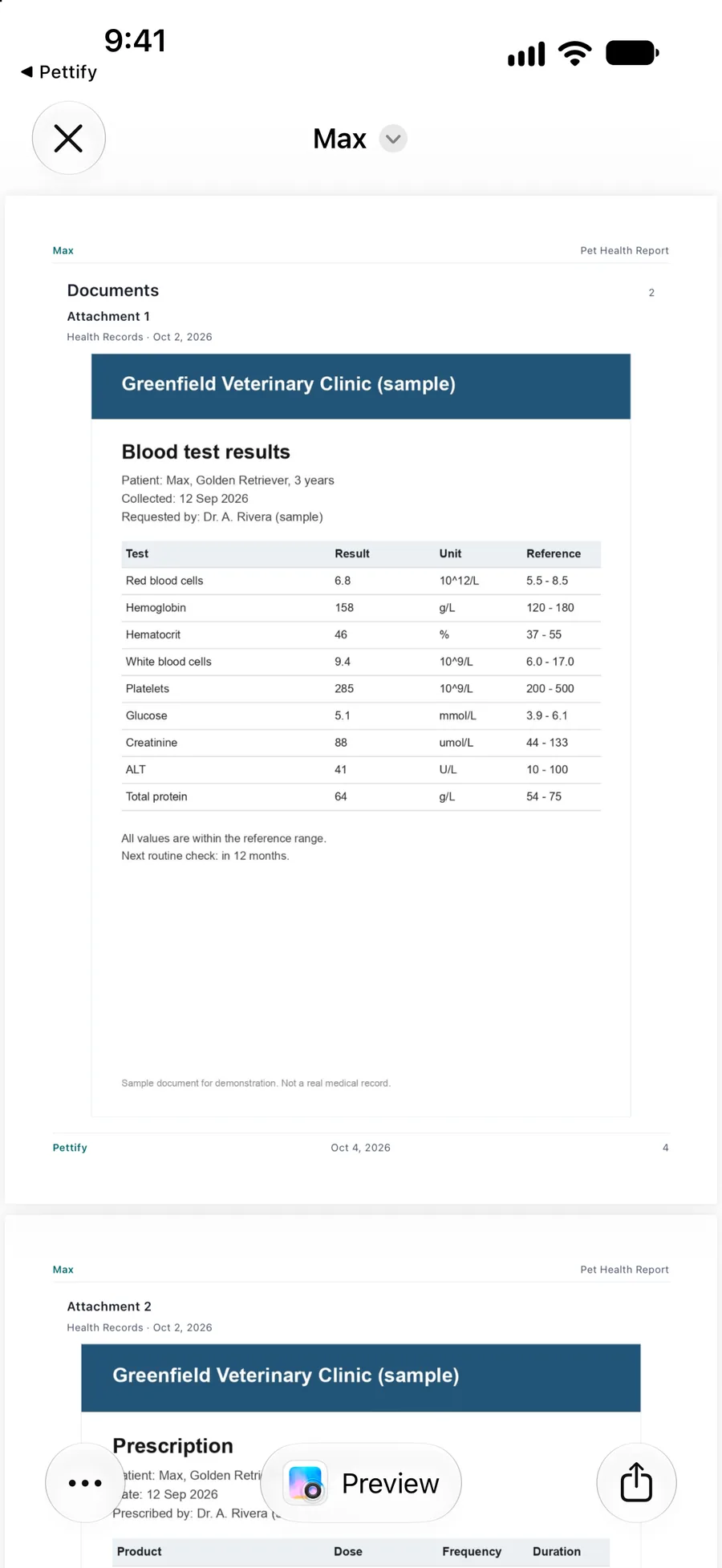
Pettify, our app for iPhone, iPad, Mac and Apple Vision Pro, keeps your pet's health records in one place: weight charts, vaccinations, and vet visits with the medicines prescribed at each one. You can scan a lab result or attach a photo or PDF, up to 10 per record.
Before the first appointment at the new clinic, export a PDF report from your pet's profile: basic details, vaccinations, vet visits, health records, the care plan and recent activity, with attached lab results and scans printed inside. You can share it straight from the app, so the new clinic has it before you arrive. It doesn't replace a health certificate or rabies certificate your vet signs.
Once a vaccination has a next date, Pettify reminds you 7, 3 and 1 day before it's due (when notifications are allowed), so a booster doesn't slip during the move. Pettify costs $4.99 a month, or $49.99 a year with a 7-day free trial (US prices).
Update the microchip and ID tag
A microchip only helps if the registry has your current details. The AVMA advises that if you've moved, or your phone number or address has changed, you update your contact information with the microchip registry as soon as possible.
- Find the microchip number. Check your pet's records, or ask your vet clinic to scan your pet: the AVMA notes that most clinics have microchip scanners.
- Find the registry. If you're not sure which one holds your pet's chip, use the American Animal Hospital Association's Microchip Registry Lookup Tool or ask your vet, as the AVMA suggests.
- Update your details. Check your phone numbers, email and address in the registry account.
- Order a new ID tag. The AVMA is clear that a microchip doesn't replace a collar with up-to-date ID tags: anyone who finds your pet can read a tag. Keep the rabies tag on the collar, too.
For the trip itself, the ASPCA suggests a temporary travel tag with your cell phone number and a phone number at your destination.
Moving with a dog vs moving with a cat
Most of the checklist is the same for both. Crate practice works the same way, as the ASPCA describes it:
- Put your pet's food inside the open crate.
- Move on to meals in the crate with the door shut.
- Carry your pet around the house in the crate, or take a short drive.
- Finish crate time with treats and play.
The differences show up in choosing the new place, packing, the car and settling in. If you're still choosing a home, the ASPCA suggests walking around the neighborhood first and watching for dogs that seem aggressive or are left unattended.
| Moving with a dog | Moving with a cat | |
|---|---|---|
| The new place | Older dogs, puppies and dogs with house-training issues need to go out often, which is harder with lots of stairs or no yard | Look for room to build vertical space, such as shelves |
| Packing weeks | Skittish dogs benefit from the same plan as cats | Cats aren't big fans of change: bring boxes in early and keep your cat in a familiar room you pack last |
| In the car | A secured crate; without one, the back seat in a harness attached to a secured seatbelt, never with its head out of the window | A well-ventilated crate or carrier, secured so it can't slide in a sudden stop |
| Settling in | A home-base room with toys, treats and bowls | The same, plus the litter box; move it toward its permanent spot about a foot (30 cm) a day |
Moving day: keeping your pet safe
On moving day, the ASPCA suggests keeping your pet in a quiet room with the door shut, or at a friend's house. That way your pet can't get scared and slip out while the movers load the truck.
If a friend takes your pet for the day, give them the same notes you'd give a sitter: our guide on what to leave for a pet sitter covers contacts, feeding and the vet. If you'd rather board your dog, see our dog boarding checklist.
For the drive, especially if you're moving with pets across the country, the ASPCA's travel safety tips include:
- Pack a travel kit: food, a bowl, a leash, a waste scoop, plastic bags, grooming supplies, medication and first aid, travel documents, a favorite toy or pillow and plenty of water.
- Feed lightly: a light meal three to four hours before you leave, and no feeding in a moving vehicle.
- Secure the crate so it won't slide or shift if you stop suddenly.
- Never leave your pet alone in a parked car. On a hot day a parked car can become a furnace, even with the windows open. In cold weather it holds in the cold like a refrigerator.
The first week in your new home
Resist letting your pet loose to explore the whole house on day one. The ASPCA notes that a new, unfamiliar space can be overwhelming, and suggests settling in step by step:
- Pet-proof first. Tuck away electrical cords, plug up nooks where your pet could get stuck, check that windows have secure screens, remove poisonous houseplants and confirm no pest-control poison traps were left behind.
- Set up a home base. Start with one room that has your pet's favorite toys, treats, food and water bowls, and the litter box for a cat.
- Open up the house slowly. When your pet seems comfortable, introduce other rooms while keeping some doors shut.
- Stick to the usual schedule. Keep meals and walks at their usual times, as you did through the packing weeks. With several pets, our multi-pet household guide shows how to keep one care table for everyone.
A move is stressful for pets as well as people. If you expect your pet to be anxious, ask your vet before moving day what can help, and don't give any calming product or medicine your vet hasn't recommended. If anything about your pet's health or behavior worries you after the move, call your new vet, or your old one if you haven't met the new clinic yet.
Frequently asked questions
Is it better to drive or fly when moving with a pet?
The ASPCA's advice is that unless your pet is small enough to ride under your seat, it's best to avoid air travel. If you must fly, it suggests booking a direct flight, using a USDA-approved shipping crate with "Live Animal" stickers and your contact details, and seeing your vet for a checkup before the trip. It also suggests telling airline staff that your pet is in the cargo hold.
Should I sedate my pet for a long move?
Don't decide on your own. For flights, the ASPCA says tranquilizing a pet is generally not recommended because it could hamper breathing, and suggests asking your vet about ways to relax a pet that may become afraid or anxious. For a long drive, ask the same question before moving day, and give your pet only what your vet recommends.
Can a microchip track my pet's location?
No. The AVMA explains that a pet microchip is not a GPS device and cannot track your animal. It usually holds only a unique identification number. When a shelter or vet clinic scans a found pet, it uses that number to find the registry, and the registry contacts the owner with the details on file. That's why those details must be current.
Is there one national database for pet microchips?
No. The AVMA notes that the U.S. doesn't have a single, centralized database for pet microchips. A chip may be registered with one or more registries, and each keeps its own records. If your pet has more than one microchip, the AVMA suggests keeping the registration updated for each one, so you can be reached whichever chip is detected.
Sources
- USDA Animal and Plant Health Inspection Service (APHIS). Take a Pet From One U.S. State or Territory to Another (Interstate). 2026. aphis.usda.gov (opens in a new tab) (accessed )
- USDA Animal and Plant Health Inspection Service (APHIS). Take a Pet From the United States to Another Country (Export). 2026. aphis.usda.gov (opens in a new tab) (accessed )
- ASPCA. Moving With Your Pet. aspca.org (opens in a new tab) (accessed )
- ASPCA. Travel Safety Tips. aspca.org (opens in a new tab) (accessed )
- American Veterinary Medical Association (AVMA). Microchipping: FAQs for pet owners. avma.org (opens in a new tab) (accessed )
- Humane World for Animals. How to Find a Veterinarian for Your Pet. humaneworld.org (opens in a new tab) (accessed )